
TOFU. MOFU. BOFU
Stop One Ad Doing Everything: Funnel ROAS Fix

Nishant Kumar
Co-founder and CEO @Marxx AI
|
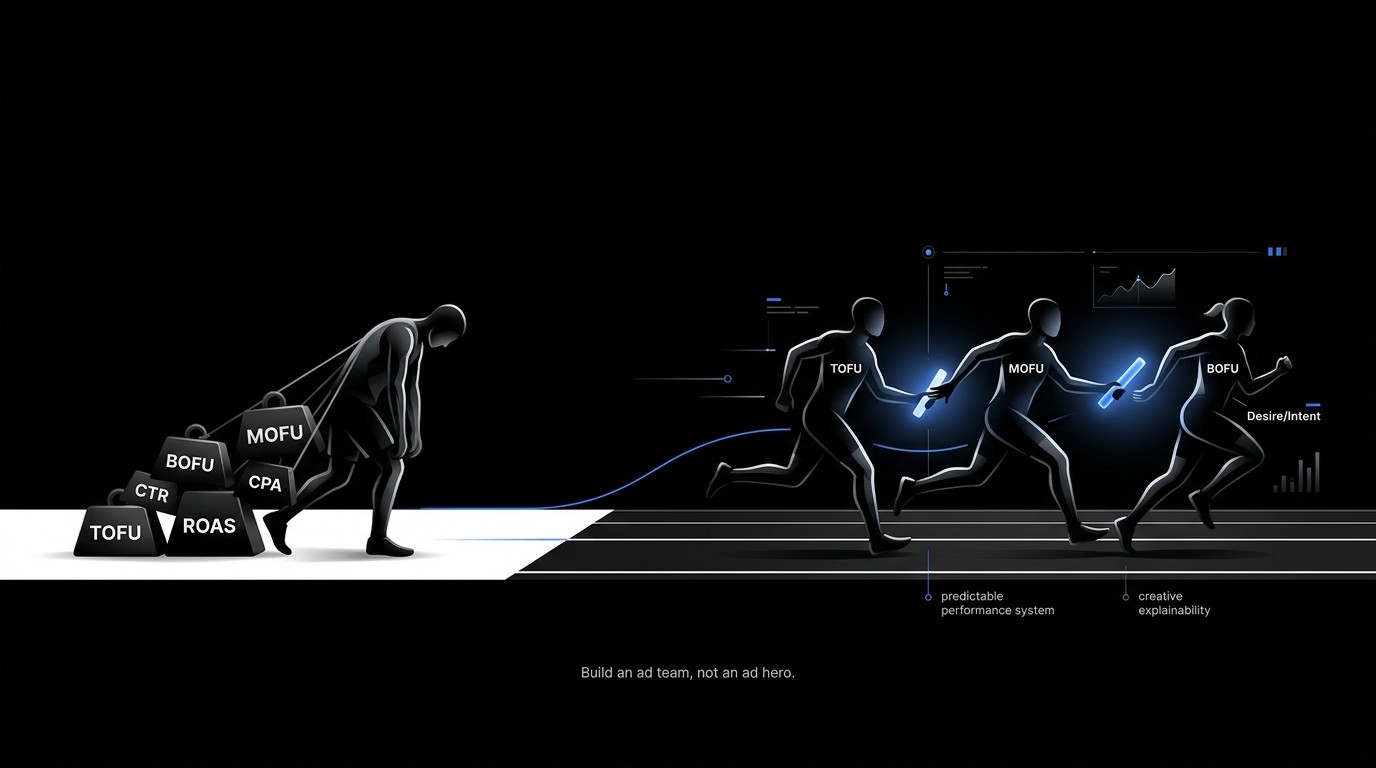
Are You Making Your Ads Work Too Hard?
Most ad accounts are built on a quiet (and expensive) assumption:
One ad should do everything.
It should stop the scroll (TOFU), earn the click (MOFU), and close the sale (BOFU)—while also delivering high engagement, high CTR, add-to-carts, checkouts, and purchases.
That’s not a strategy. That’s a job description no single ad can consistently fulfill.
In organizations we call it teamwork.
With AI agents, we call it agent work.
So why is your one ad responsible for the entire funnel?
The Most Common Performance Mistake We See (Across 500+ Audits)
At Marxx AI, we’ve audited 500+ brands and agencies. One pattern shows up again and again:
Everyone runs “sales” campaigns for TOFU.
Meaning: we ask cold audiences to buy immediately, then act surprised when performance looks like this:
Low ROAS
High drop-off between click → checkout
Rising CPMs and CPA over time
Ad fatigue (and “creative burnout”)
A constant feeling that “Meta is broken” or “the ad just stopped working”
Then we blame the ad. Or the platform. Or the algorithm.
But the real issue is structural:
You’re forcing a single creative to carry the full funnel.
The Truth: Not All Ads Are Meant to Do All
Performance marketing is a system, not a lottery.
And systems work best when each part has a clear role.
When you assign a single ad to handle:
awareness and
consideration and
conversion…
…you dilute everything that makes it persuasive.
Specialized ads win because they’re designed for a single objective, a single mindset, and a single next step.
The Funnel Should Work Like a Team
Think of your ads like a high-performance team. Each person has a role. Each role moves the mission forward.
Here’s the structure we use—and what consistently fixes stagnating accounts:
1) Backend Ads = Awareness (TOFU)
Objective: Earn attention and engagement.
Audience: cold
Success signals: thumbstop rate, video holds, saves, shares, profile taps
This is where you build familiarity. Not force a purchase.
Backend ads make the audience warmer. They reduce friction for the next step.
2) Backend Ads (Layer 2) = Interest (MOFU)
Objective: Turn engagement into intent.
Audience: people who engaged (video viewers, engagers, profile visitors)
Success signals: outbound clicks, landing page views, time on page
These ads answer:
“What is this?”
“Is it for me?”
“Why should I care?”
You’re not closing yet—you’re qualifying.
3) Desire Ads = Action Builders (Lower MOFU)
Objective: Drive high-intent behaviors.
Audience: site visitors, product viewers, engagers with intent signals
Success signals: add-to-cart, initiate checkout, return visits
This is where proof matters:
product clarity
offer clarity
risk reversal
outcomes
differentiation
You’re removing doubt and increasing certainty.
4) Frontend Ads = Outcome (BOFU)
Objective: Close.
Audience: cart/checkout users, high-intent retargeting pools
Success signals: purchases, ROAS, CPA, MER impact
These are your “nail-in-the-coffin” campaigns:
urgency
guarantees
direct comparisons
tight offer framing
objection destruction
strongest proof stacks
They don’t need to educate. They need to convert.
Why This Works (And Why “One Ad Does All” Fails)
Every stage of the funnel requires a different creative job:
TOFU needs relevance and pattern interrupts.
MOFU needs clarity and persuasion.
BOFU needs certainty and risk reduction.
When you ask one ad to do all three, it becomes generic:
too “salesy” for cold audiences
too vague for high-intent audiences
too broad to optimize efficiently
And the entire funnel breaks at its weakest link.
If your TOFU doesn’t build quality engagement, your MOFU costs spike.
If MOFU doesn’t build intent, BOFU can’t close without discounting.
If BOFU isn’t engineered to overcome friction, you’ll blame traffic quality forever.
The Result: ROAS Doesn’t “Improve”—It Unlocks
We’ve seen this play out repeatedly.
Once we implemented this specialization model for clients, stagnant ROAS jumped from 1.7 (consistent for 6 months) to 3.9—because the account finally started operating like a performance system instead of a creative guessing game.
Not more ads.
Not more spend.
Better role clarity across the funnel.
Quick Self-Audit: Are You Making Ads Work Too Hard?
If you answer “yes” to any of these, you’re likely forcing one creative to carry the funnel:
Are you running conversion campaigns to cold audiences with purchase-focused ads?
Are you judging every ad primarily by ROAS—regardless of where it sits in the funnel?
Do you have no clear separation between engagement ads, click ads, and closing ads?
Are you seeing frequent fatigue and inconsistent winners?
If so, the fix isn’t “new creatives.”
The fix is specialization.
The Takeaway
Your ads aren’t underperforming because they’re bad.
They’re underperforming because they’re overworked.
Stop asking one ad to:
create awareness
generate intent
close sales
and remain profitable forever
Build an ad team, not an ad hero.
And make every creative earn its place in the funnel.