Scattered tools
The 8-Tab Problem in Performance Marketing

Nishant Kumar
Co-founder and CEO @Marxx AI
|
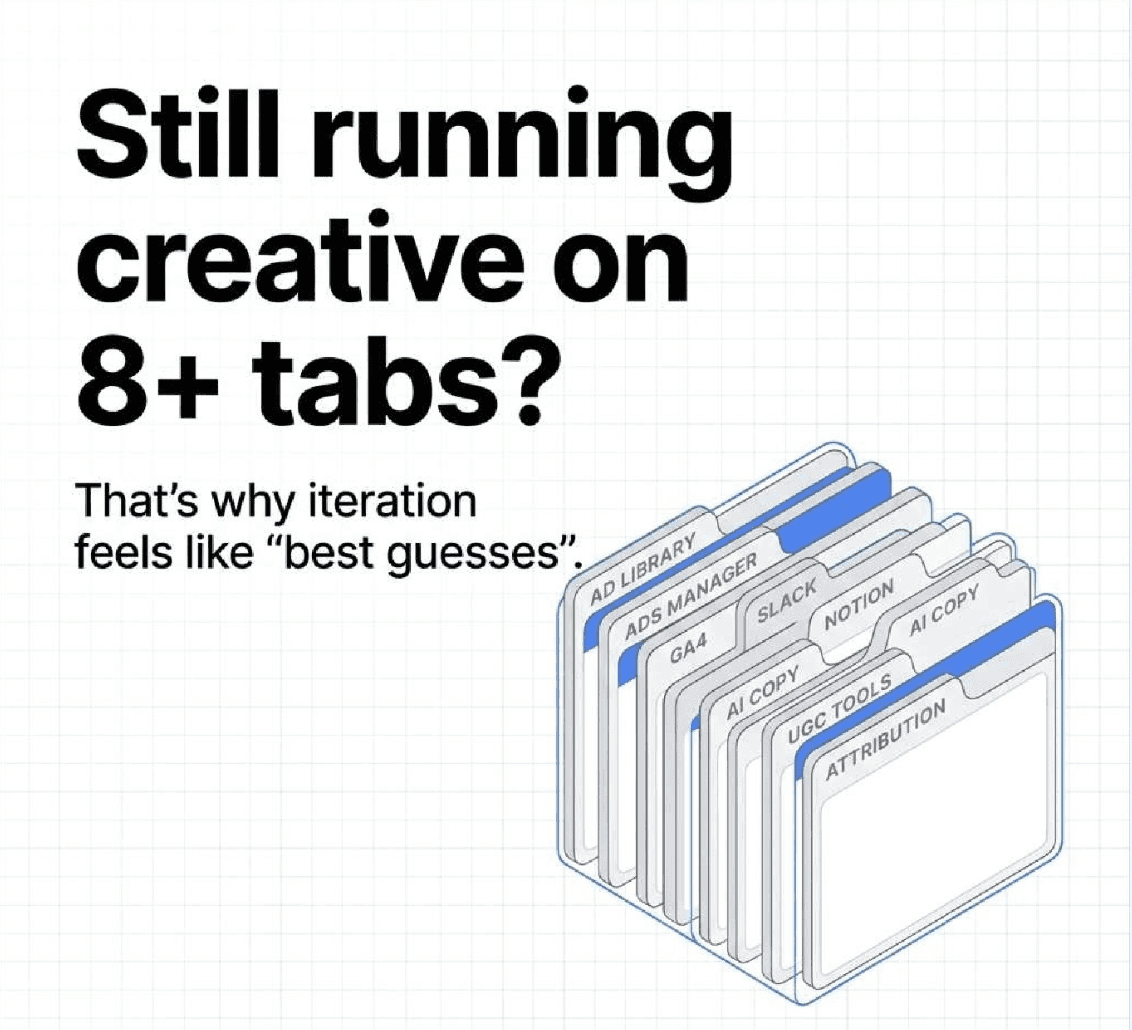
Most performance marketers aren’t running sophisticated systems—they’re managing a growing number of disconnected tabs. And despite having access to the best tools, they still end up shipping campaigns based on educated guesses.
Modern performance marketing stacks look powerful on the surface. A typical workflow involves tools like Meta Ad Library and Google Ads Transparency Center for competitor research, ChatGPT or Gemini for copy generation, and creative platforms such as Midjourney, Runway, or Kling.
On top of this, teams rely on tools like HeyGen and Creatify for UGC-style ads, while performance is tracked across Meta Ads Manager and Google Ads.
Individually, each tool is powerful. But collectively, they create fragmentation. Insights are scattered. Context is lost. Execution slows down.
Why Fragmentation Breaks Performance
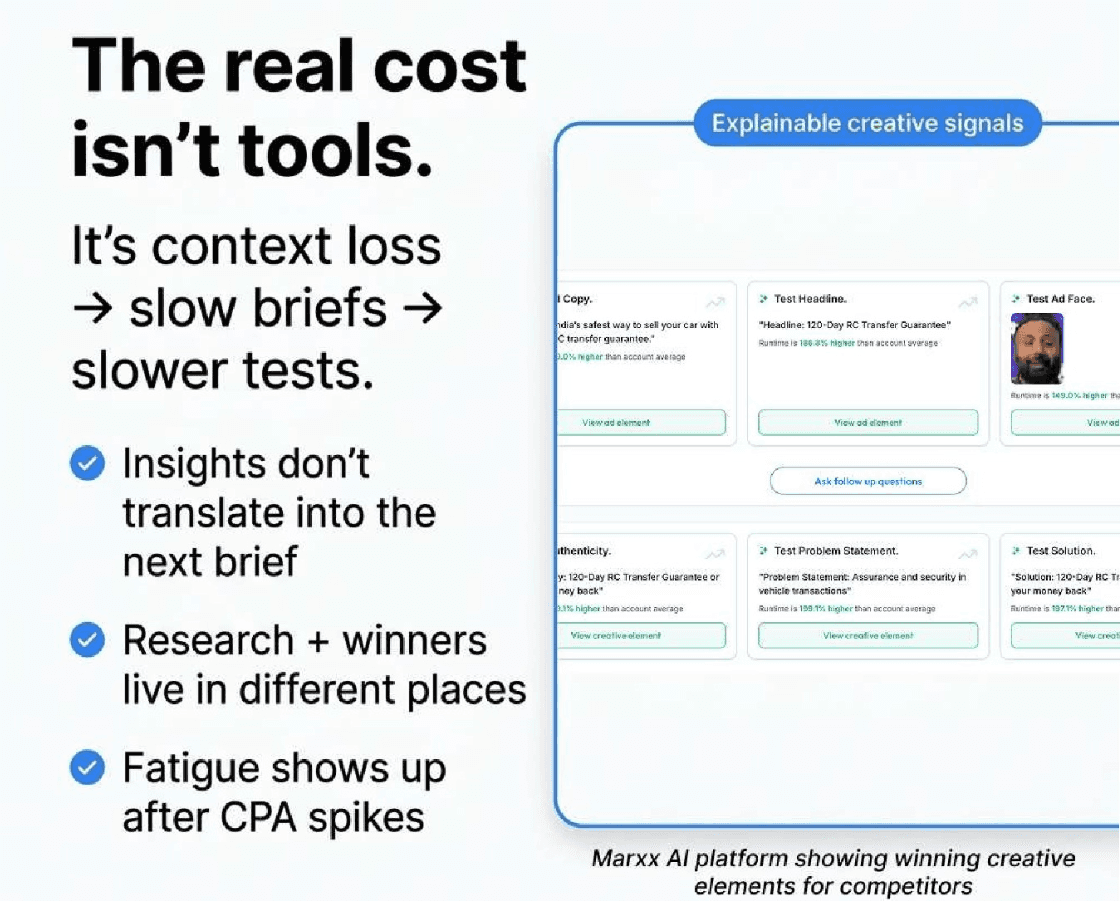
Insights Don’t Flow Across the Workflow
Each tool captures a piece of the puzzle:
Research tools show what competitors are doing. Creative tools generate assets. Dashboards show performance. But these insights rarely connect. What worked in one campaign doesn’t seamlessly inform the next.
Context Gets Lost Between Teams and Tools
Performance data lives in dashboards. Creative iterations live in folders. Learnings sit in Slack or internal docs. This disconnect creates gaps where:
Winning angles go unnoticed
Learnings don’t compound
Teams operate on partial information
Execution Becomes Slower Than It Should Be
Switching between multiple tools introduces friction:
More coordination
More manual work
More delays in iteration
What should take days often takes weeks.
Feedback Loops Are Broken
At its core, performance marketing is a feedback system:
What worked → Why it worked → What to create next
When this loop is fragmented, teams reset with every campaign instead of building on past learnings.
Practical Application: Building a Connected Workflow
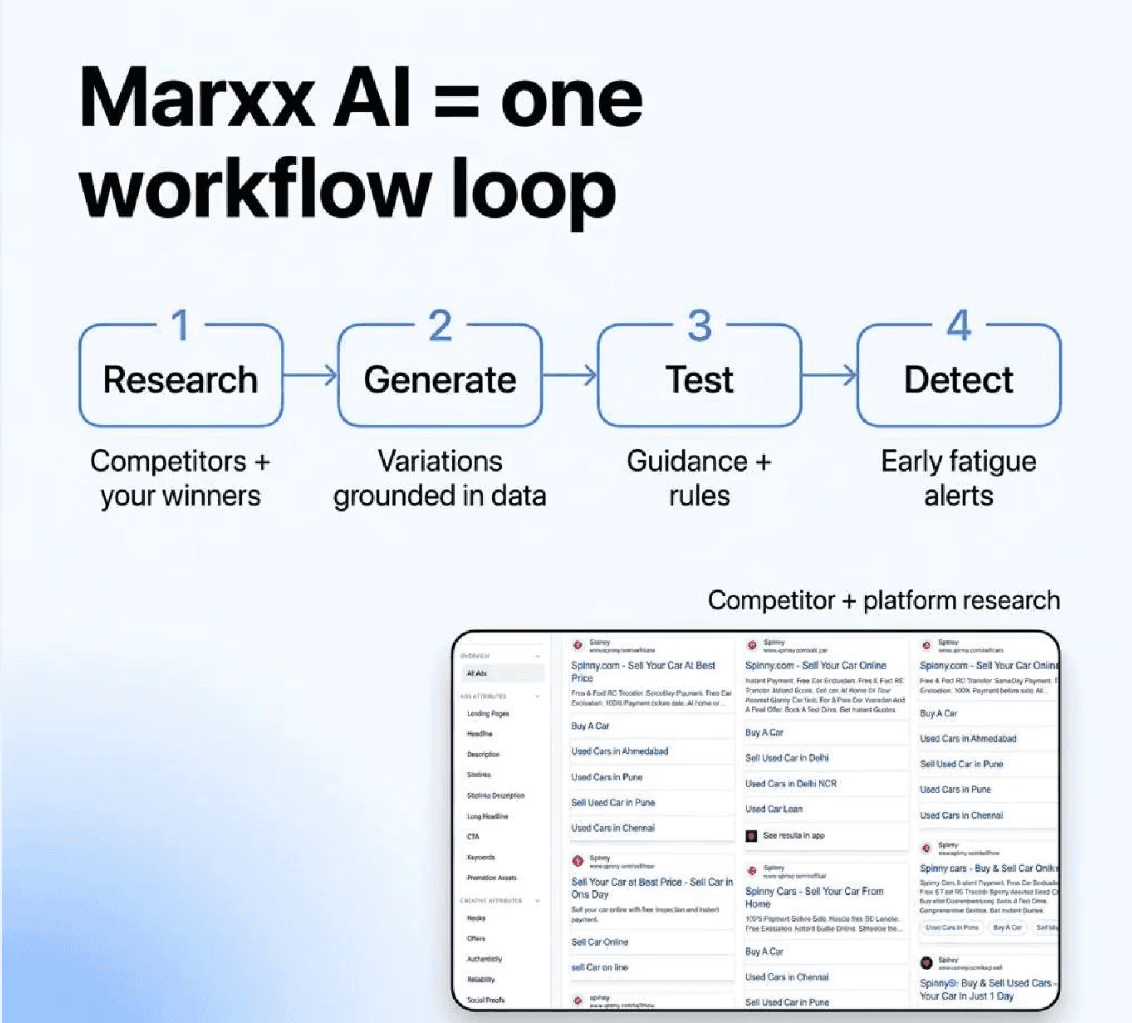
To move from fragmented execution to a performance system, teams need to focus on continuity.
Step 1: Centralize Research and Performance Data
Bring competitor insights and historical performance into one view.
Step 2: Generate Creatives Based on Real Signals
Avoid creating ads in isolation. Use past winners and trends to guide variations.
Step 3: Pre-Test Before Scaling
Validate creative directions early using data, not intuition.
Step 4: Monitor and Detect Fatigue Early
Set up systems to identify performance drops before they impact results.
Step 5: Close the Feedback Loop
Ensure every campaign feeds into the next:
Capture insights
Translate them into new creatives
Test and refine continuously
Platforms like Marxx AI are designed around this principle - connecting research, creative, and performance into a unified reusuable workflow.
Conclusion
Most performance teams don’t have a tooling problem.
They have a workflow problem.
Key takeaways:
More tools ≠ better performance
Fragmentation breaks learning loops
Connected workflows accelerate iteration
If you’re running Meta and Google at scale, take a step back and audit your workflow.
How many tabs are open right now?
If it’s more than eight, it might be time to rethink the system.