
Nvidia Inception
Why NVIDIA Inception Is a Force Multiplier for Marxx AI
Nishant Kumar
CEO and Co-founder, Marxx AI
|
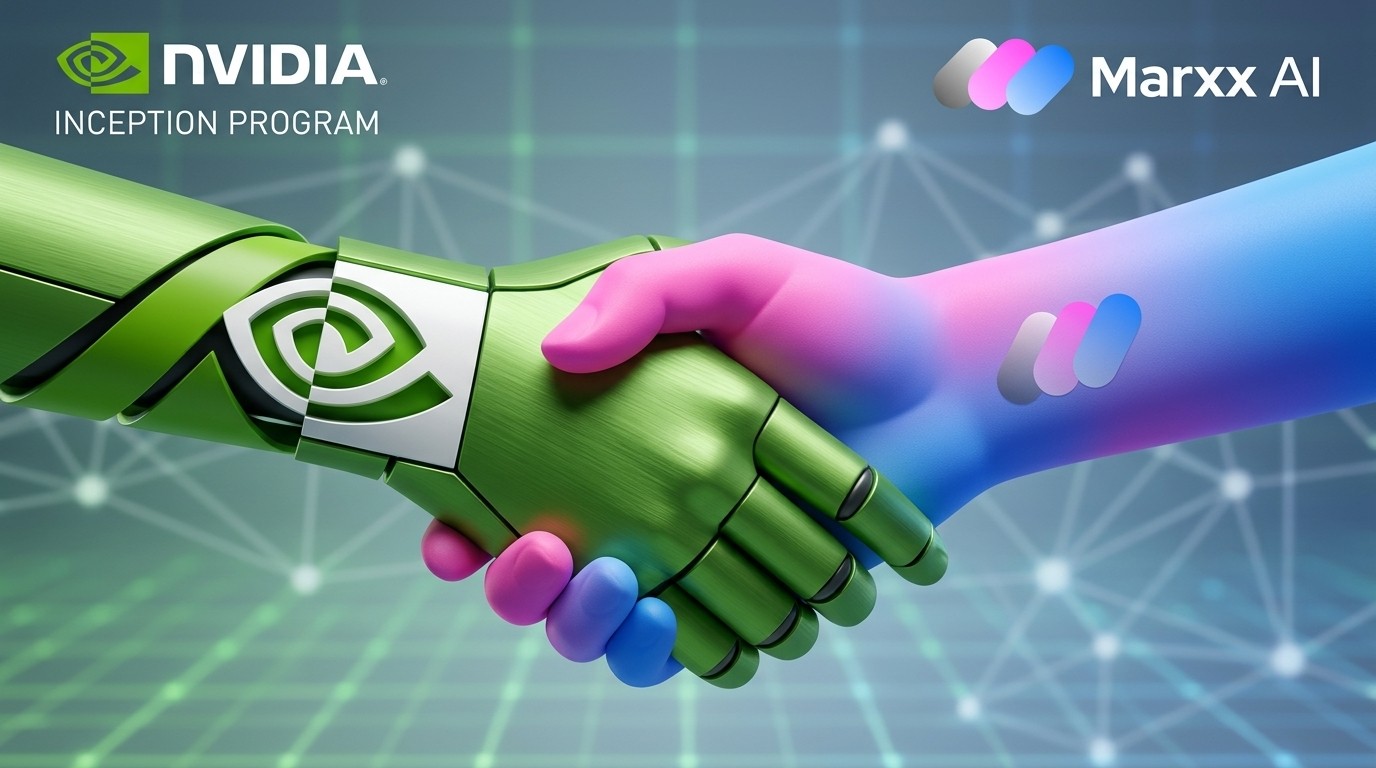
We just got accepted into NVIDIA Inception—and it’s not a badge. It’s leverage.
Most startups celebrate partnerships like trophies.
We don’t.
Because in performance marketing, celebration doesn’t compound. Execution does.
Marxx AI has officially been accepted into the NVIDIA Inception program—NVIDIA’s program designed to help companies build faster and accelerate growth with benefits, tooling, and ecosystem support.
And if you know how we think, you already know what this means:
More speed. More iteration. More signal.
Less guesswork. Less wasted spend. Less “creative roulette.”
This post breaks down what NVIDIA Inception unlocks for Marxx AI—and why it directly connects to the way we believe winning ads are built: systematically, at scale, with proof.
What NVIDIA Inception is
NVIDIA Inception is a program built to help AI-first companies ship faster and grow smarter.
Not with vibes—through practical support:
Infrastructure and ecosystem access
Technical resources and acceleration
A pathway to credibility and distribution as you scale
NVIDIA’s email said it clearly: the program is designed to help companies build solutions faster and accelerate growth.
That’s exactly the game we’re playing.
Because in our world, the bottleneck isn’t “ideas.”
It’s the ability to turn insights into tested creatives before your competitors do.
What Marxx AI actually does (and why the market keeps losing money)
Marxx AI is an AI-powered performance marketing platform that helps social ad teams and agencies:
Build winning creatives faster
Test the right creative variations (not random ones)
Scale what works with less waste
Under the hood, Marxx analyzes 400M+ ads to extract what we call Brand DNA—the patterns, angles, and creative elements that actually drive outcomes.
Here’s the uncomfortable truth most ad teams live with:
They’re “testing,” but they’re not running a system.
They’re running a lottery.
A few new hooks. A few new edits. A few new angles.
Then hoping the algorithm “finds the buyers.”
Our thesis is different—and it’s sharper:
You don’t need a lot of creatives.
You need enough creatives that come from research (the sets most likely to produce winners).You must test the matrix:
personas × products × competitor-winning angles × your winning angles × trending ad types × media types × creative elements90% of ads will fail. That’s not a tragedy. That’s the process.
The hook is the highest-leverage variable. But it has to be calibrated:
Too broad → everyone watches → algorithm learns nothing → CTR/ROAS drop
Too weak → no one watches → algorithm learns nothing → you burn money
The right hook filters: buyers stop, non-buyers scroll
And if you don’t get enough conversion events (often ~50 events per ad set) the platform stays in the learning phase and you’re basically paying for confusion.
Marxx exists to make this whole machine more predictable.
Why NVIDIA Inception is a force multiplier for “Brand DNA → Performance System”
If you’re building AI that touches creative, you’re fighting three wars at once:
Speed (can you iterate faster than the market?)
Scale (can you run the full testing matrix without drowning your team?)
Signal (can you separate “interesting” from “profitable” before spend piles up?)
NVIDIA Inception strengthens our ability to win those wars.
1) Faster iteration cycles (the only real advantage in creative)
Creative is a moving target.
The “winning” hook from last month becomes background noise this month. New trends emerge. Competitors copy. Audiences fatigue.
So the only durable advantage is the ability to:
Extract patterns faster
Generate more testable hypotheses
Ship more high-quality variations
Learn quicker from failure
Inception is aligned with that reality: build faster, accelerate growth.
And for Marxx AI, faster build cycles directly translate into faster customer outcomes.
2) More capacity to test what matters (not what’s convenient)
Most teams test what they can produce.
Not what they should test.
That’s why they get stuck in “incremental tweaks” instead of breakthroughs.
Our approach is explicit: test the full matrix—personas, products, angles, formats, media types, elements. That’s how you find winners quickly.
NVIDIA Inception supports the type of platform building required to operationalize that philosophy—so the system can handle more complexity without your team doing more manual work.
3) Better creative explainability (so performance isn’t a black box)
We’re aggressively opinionated on this:
If you can’t explain why an ad won, you can’t reliably scale it.
Marxx is built around creative explainability—connecting performance back to specific inputs: hook type, angle, structure, visual language, offer framing, pacing.
That maps directly to our brand values:
Data-driven innovation
Scalability
Creative explainability
Efficiency
Inception strengthens our ability to keep pushing here—so “AI for ads” doesn’t become another black box that teams can’t trust.
What this means for brands and agencies using Marxx AI
Let’s translate the announcement into outcomes you actually care about.
You get to a winner with fewer wasted cycles
Not fewer tests.
Fewer wasted tests.
Because the goal isn’t to reduce experimentation. The goal is to increase the percentage of experiments that are worth running—based on research and proven creative sets.
You spend less time debating opinions, more time shipping proof
You’ve seen this meeting:
“I don’t like this hook.”
“This doesn’t feel on brand.”
“My gut says this won’t work.”
Meanwhile, the competitor is already on version 27.
Marxx is built to move teams from taste-driven decision-making to performance-driven iteration—without sacrificing brand consistency (that’s what Brand DNA is for).
You stop feeding the algorithm noise
Platforms don’t reward randomness.
They reward clean signals.
That’s why hook calibration matters so much: the right hook creates useful filtering, which improves delivery quality over time.
And that’s also why hitting enough conversion events matters—if the ad set never exits learning, you’re not scaling, you’re donating.
The full-circle moment: this isn’t about NVIDIA. It’s about compounding.
Yes, we’re excited to join NVIDIA Inception.
But the real point is what it enables:
A faster path to the thing we care about most—helping brands and agencies turn advertising into a repeatable performance system, not a monthly creative scramble.
If you’re building and scaling with Marxx AI, expect us to move quicker, ship more, and go deeper on the one thing that actually matters:
finding winners—on purpose.
If you want to see how Marxx turns your Brand DNA into a scalable creative testing engine, reach out. We’ll show you the system.