Advertising loves to pretend it’s a science of prediction.
Right message. Right angle. Right audience. A clean equation marketers try to solve- by isolating variables, running tests, and chasing certainty.
But reality doesn’t behave like a spreadsheet. Most ads don’t win. Most aren’t even remembered.And that’s not failure, that’s the system working exactly as it should.
This report breaks down why creative inconsistency is not a flaw, but a feature and what that means for how modern creative strategy actually needs to operate.
We analyzed an anonymized dataset of 550,000+ ads from 6,000+ advertisers, representing approximately $1.3B in spend across Facebook and Instagram between September 2025 and early Februrary 2026.
This period captures the most volatile and competitive window in advertising, from pre-holiday experimentation to the intensity of Black Friday / Cyber Monday, followed by the post-holiday reset where performance narratives get rewritten.
Three patterns emerge and they challenge how most teams think about creative performance:
1. Winning ads are outliers, not expectations.
Only ~5% of ads reach 10× their account median spend. That’s not a creative failure that’s pure math.Performance advertising doesn’t reward consistency. It rewards spikes. The system is designed so that a handful of ads carry the weight, while the majority quietly fade out.
2. Scale doesn’t change the game — it increases your shots.
Larger advertisers don’t “crack the code.” They simply generate more variation.
More creatives → more experiments → higher probability of hitting winners.
Smaller advertisers aren’t locked out of performance, they’re just operating with fewer lottery tickets.
3. Trends don’t travel as well as you think.
What’s popular isn’t always what performs. The formats everyone copies often saturate fastest, while real performance shifts based on:
account scale
category dynamics
timing in the cycle
and how crowded the creative landscape is
In other words — context beats convention.

This report isn’t built to hand out tips. .It’s built to map the system.
Performance advertising doesn’t operate on isolated wins, it’s shaped by underlying mechanics that determine what gets seen, scaled, and sustained. What we’ve done here is decode those mechanics, the forces that quietly govern how successful ad accounts actually behave beneath the surface.
These benchmarks are not answers. They are context.
And with the right context, teams can finally ask, and answer, the questions that actually matter.
Because at its core, creative strategy keeps circling the same four questions:
1. How fast are we generating new creative opportunities?
(not just how many ads we launch but how often we create chances to win)
2. How often do we discover real outliers?
(not every “good” ad, only the ones that truly scale)
3. What patterns exist across our winners?
(not trends we copy, signals unique to our account)
4. Where are we under-leveraged compared to the market?
(not vanity benchmarking, actual gaps in our system)
Part 1: The Search for Winners
Creative volume is not a tactic. It’s an unfair advantage.
Across industries, budgets, and account sizes — one pattern refuses to change:
The advertisers who launch more ads, find more winners. Not because they’re better at predicting outcomes.
But because they’re operating correctly in a system where outcomes are inherently unpredictable.
Performance on platforms like Meta doesn’t behave like strategy.
It behaves like probability.
~50% of ads receive little to no spend
A tiny fraction ~6% drive the majority of spend within an account
This isn’t inefficiency. It’s concentration.
A small set of ads carry disproportionate impact. Everything else exists to discover them.
Which means every new creative isn’t just “another ad.” It’s another shot at hitting the few outcomes that actually matter.
The implication is simple, but uncomfortable:
You don’t scale by being right more often. You scale by increasing the surface area for luck to happen and recognizing it fast when it does.
What separates stronger advertisers isn’t sharper intuition. It’s a faster, more disciplined testing engine.
They don’t rely on being right. They rely on generating enough ideas for something to become right and catching it early when it does. This pattern holds even when budgets are similar.
Yes, bigger budgets enable more testing. But budget alone doesn’t explain performance gaps.
Cadence does.
The speed at which new creatives are launched and cycles are completed is what consistently separates top-performing brands from everyone else.
Volume doesn’t improve the average. It improves the odds.
More ads don’t make your creative better. They increase the likelihood of encountering something exceptional. And in a system where outsized wins are rare but disproportionately valuable that difference is everything.
The strategic shift is subtle, but critical:
Don’t aim to be certain. Aim to be in the game more often. Because in performance advertising, frequency of participation beats accuracy of prediction.
Winners are rare — by design, not by accident.
If spend were distributed evenly, performance would be a game of optimization. Tweak the inputs. Improve the average. Scale predictably. But that’s not the system we’re operating in.
On platforms like Meta, spend doesn’t spread. It concentrates.
Most ads receive little to no spend
A small minority capture a disproportionate share
This isn’t inefficiency. It’s how the system identifies what deserves to scale.Which means performance isn’t driven by lifting the average. It’s driven by discovering the few ads that break away from it.
The implication:
You don’t win by making all ads slightly better. You win by finding the few ads that are significantly better.And accepting that most of what you launch… won’t be.
This reframes one of the most common frustrations in performance marketing. When results feel inconsistent, the instinct is to diagnose failure.
Why didn’t this ad work? What went wrong?
But in a system where most ads are expected to fail, that question has limited value.
An ad that doesn’t spend isn’t always weak. It’s often just… normal.
The real leverage comes from asking a different question:
Why did this ad work? Because winners are the anomaly. And anomalies carry signal.
Rethinking Hit Rate
Hit rate is often treated like a report card.
A high percentage = strong intuition.
Low percentage = weak creative judgement.
It feels logical. But it’s deeply misleading.
A high hit rate doesn’t always signal strength. It can signal restraint.
When hit rates look “too good,” it often means fewer risks are being taken, fewer ideas tested, fewer edges explored.
And in a system that rewards outliers, playing it safe comes at a cost.
Two accounts can show identical hit rates and operate in completely different realities.
One tests very little, backs most of what it launches
The other runs aggressively, cycles through ideas, and surfaces a few breakout winners
On paper, they look similar.
In practice, one is compounding, the other is plateauing.
Because here’s the paradox:
The more you test, the lower your hit rate tends to look. Not because you’re getting worse but because you’re finally operating at the edge where real wins exist.
So the goal isn’t to protect your hit rate. It’s to break it.
Because a lower hit rate, paired with higher volume, is often the clearest signal that an account is actually built to scale.
This is why hit rate, on its own, is incomplete.
A high hit rate can reflect strong judgment. It can just as easily reflect limited exploration. The number doesn’t tell you which one you’re looking at.
Accounts that test more ideas naturally produce a wider spread of outcomes:
more average ads
more failures
and more breakout winners
Which means lower hit rates often show up in the very accounts that are pushing hardest on growth.
Hit rate still matters. But it needs to be interpreted correctly.
It’s not a measure of success. It’s a description of how often rare events occur within your system.
And in performance advertising, success isn’t about how often you win.
It’s about what happens when you do.
Mid-Range Spenders & Portfolio Logic
Between clear winners and obvious losers sits a third category, one that rarely gets attention, but quietly holds the system together:
Mid-range spenders.
These ads don’t break out. They never dominate spend. But they also don’t disappear. They keep running. They absorb budget. They stabilize performance. In most accounts, this layer does the unglamorous work:
While winners drive spikes, mid-range ads sustain continuity.
Think of it as a portfolio, not a leaderboard.
Winners = outsized returns
Losers = exploration cost
Mid-range = operational backbone
Across spend tiers, this middle layer consistently represents a meaningful share of active ads. Which means performance isn’t just about finding the few ads that win. it’s also about maintaining a base that keeps delivery stable while those winners are being discovered.
The shift in thinking:
Don’t judge every ad by its ability to become a winner. Some ads exist to support the system, not outperform it.
When you zoom out and look at spend through a portfolio lens, the pattern becomes clear:
Winners dominate but they don’t operate alone.
They typically absorb the largest share of spend, acting as the primary growth drivers in an account.But right behind them sits the overlooked layer:
Mid-range ads continue to carry meaningful weight.
Especially in smaller accounts. This isn’t accidental. It’s structural. Smaller accounts don’t generate winners as frequently. So the system leans more heavily on mid-range performers to maintain delivery and consistency.
In other words:
Large accounts scale on winners
Smaller accounts survive on the middle
And this is where most strategies go wrong. They over-focus on chasing the next winner, while underestimating the role of ads that simply… keep things working.
The implication:
A healthy account isn’t just one that finds winners. It’s one that balances:
discovery (losers)
stability (mid-range)
scale (winners)
Because performance isn’t a single spike. It’s a system that needs all three layers to function.
How Many Ads Should You Be Testing?
There’s no single number that defines the “right” testing volume. Because testing isn’t just a strategy decision. It’s a function of resources, velocity, and system design.
The ideal volume depends on three constraints:
how much budget you can deploy
how quickly your team can produce ideas
how efficiently your workflow can turn ideas into live ads
Which is why creative output varies so widely across accounts. Some advertisers launch a handful of ads each week. Others operate at a much higher cadence.
Not necessarily because they think differently but because they’re built differently.
Testing volume is not just about ambition. It’s about capability.
The benchmarks below reflect this reality. They show median testing volumes across:
industries
and spend tiers
Not as targets to blindly chase but as context for where you stand, and what your system is currently capable of supporting.
Because the real question isn’t:
“How much should we test?” It’s:“How much can our system sustain — without breaking?”
Creative volume scales with ambition. As advertisers move up spend tiers, they don’t just spend more — they put more ideas into the system. More ads launched each week leads to more shots on goal, more winners surfacing, and stronger overall performance signals.
This isn’t just about budget. It’s about build. The best advertisers design systems that can generate, test, and iterate faster. Creative production, feedback loops, and decision-making all move with speed. That is what unlocks consistent discovery.
Even within the same spend tier, the difference is clear. Top advertisers ship significantly more creative than the average. Not slightly more. Materially more. And that gap compounds over time into a structural advantage.
Creative Output is a Capacity Problem
For smaller advertisers, launching a few ads each week can be enough to surface winners. But as brands scale, that same pace becomes a bottleneck. It limits how many real opportunities exist to find something that truly works.
At higher spend levels, conservative output doesn’t just slow growth. It quietly caps it. If you are not putting enough ideas into the system, you are not giving winners a chance to show up.
The real question is simple:
Are we shipping enough to make success possible? Most teams don’t optimize for this. They anchor output to what feels manageable. What their workflows, approvals, and production cycles can comfortably handle.
But that constraint is rarely strategic. It’s organizational.
Creative strategy is not just about making better ads. It is about building the capacity to produce enough of them.
Because in a system where wins are rare, growth belongs to the teams that create enough surface area for them to appear.
Part 2: The Anatomy of Winning Ads
What should you actually be testing?
If performance behaves like probability, then not all creatives are equal. Some formats, hooks, and assets consistently give you better odds. Not guaranteed wins. Better odds.
This is where creative strategy becomes real leverage.
There is no fixed formula for what will scale. But there are patterns behind what repeatedly does. The job is not to guess outcomes. It is to recognize signals early and lean into them faster than others.
What the industry calls “trends” is often just pattern recognition at scale. Not opinions. Not isolated wins. But repeated signals across thousands of ads.
To make this actionable, we look at two simple lenses:
Hit rate → How often does this type of ad produce winners?
Spend concentration → When used, how likely is it to attract budget?
Read them together, not in isolation:
Above 1.0 → Punches above its weight
Around 1.0 → Performs as expected
Below 1.0 → Overused relative to impact
The shift:
Stop asking “what’s trending?” Start asking “what is statistically earning attention and spend?” That’s where real creative advantage lives.
Not all formats play the same role. And that’s the point.
Some sit right at the intersection of frequency and scale. Offer-led banners and product demos show up consistently across both dimensions. They are dependable. Easy to produce. Easy to scale when performance matters.
These are your scale formats.
Then you have formats with high hit rates but lower spend concentration. Unboxings, POVs, behind-the-scenes, founder-led content. These don’t always scale widely. But when they hit, they hit hard.
These are your volatility formats.
Less predictable. More explosive. On the other end are formats that absorb spend but rarely break out. High-volume, widely used, but inconsistent in producing winners. They still matter.
These are your coverage formats.
They expand exploration. They increase surface area. They keep the system learning. So the real takeaway is simple:
Some formats are built to scale
Some are built to discover
Some are built to sustain
The strongest advertisers don’t chase one category. They orchestrate all three. Because performance doesn’t come from a single format. It comes from a system where each format plays its role.
Why Top Visual Styles Differ by Vertical
“Top-performing creatives” sounds universal. In reality, performance is local. What works in one category often fails quietly in another.
Because every vertical plays by its own rules of attention, trust, and intent. When you break performance down by vertical, the differences become obvious:
Fashion rewards cultural fluency, speed, and playfulness
Finance & professional services lean on credibility, clarity, and explanation
Home & lifestyle responds to demonstration, process, and tangible outcomes
Same platforms.Completely different signals. This changes how benchmarks should be used.
Cross-industry trends tell you what exists. They don’t tell you what wins in your arena.
The real edge comes from contextual relevance:
What formats are earning attention in your category?
What styles are actually getting spend from competitors targeting the same audience?
Because creative strategy isn’t about copying what works globally. It’s about aligning with what resonates specifically where you compete.
The shift:
Stop chasing platform trends. Start decoding category behavior. That’s where sustainable advantage is built.
Top Hooks & Headlines
Everyone wants a list of “winning hooks.” But hooks don’t win in isolation. They win in context. When you look across both frequency and spend, a few patterns show up consistently:
Clarity converts.
Hooks that signal immediacy, value, or a clear reason to act show up again and again.
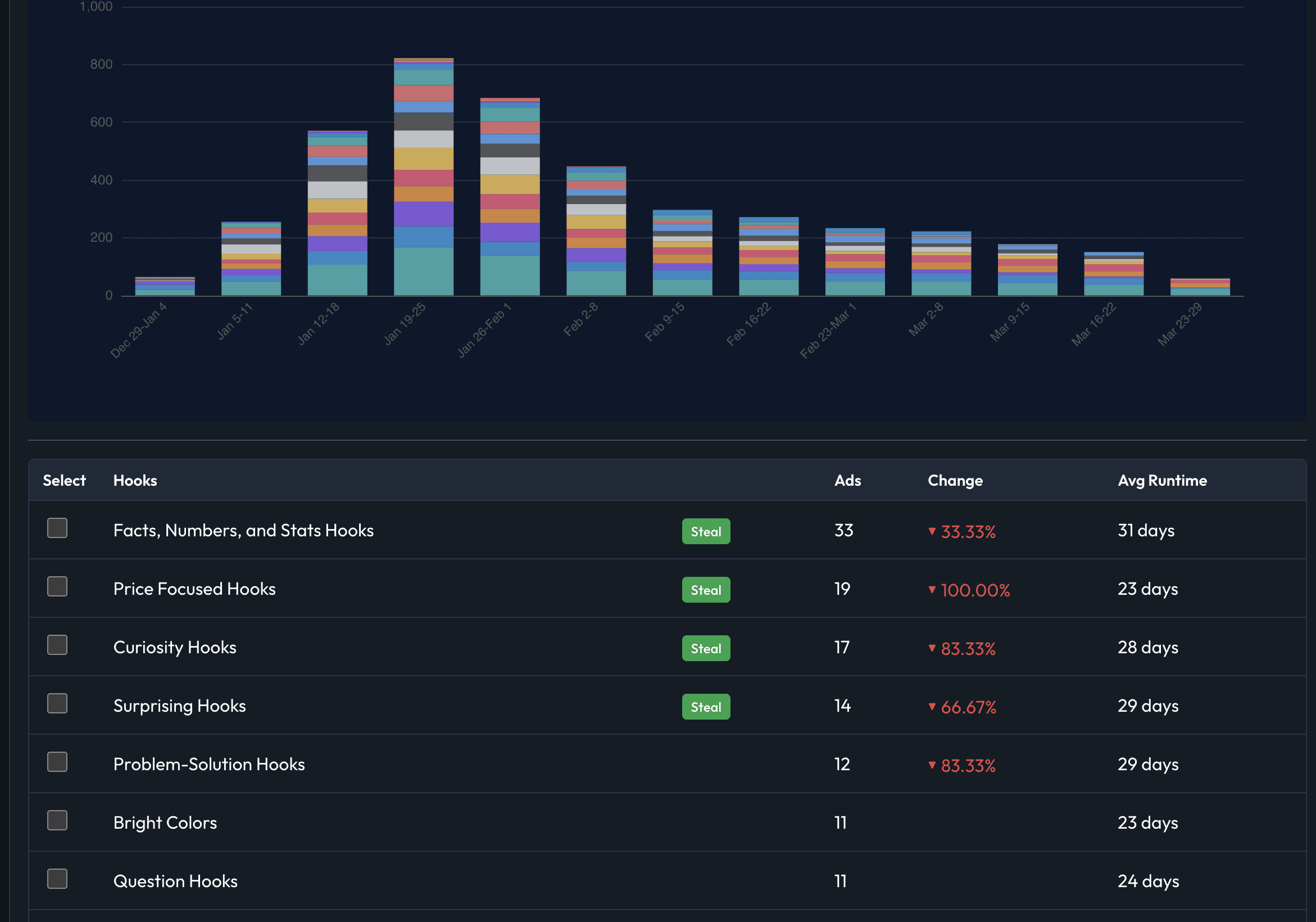
price framing
offers and urgency
product drops or newness
These reduce thinking. They tell the user exactly why this matters, right now. Then there’s a different class of hooks.
Attention-first hooks.
These don’t lead with value. They lead with interruption.
curiosity gaps
confessional tones
bold or unexpected claims
They create tension. And tension buys attention.
What’s missing is just as important.
Broad lifestyle messaging. Vague benefit-led statements. They’re everywhere in advertising. But they rarely show up among actual winners. Because when attention is scarce, anything that delays clarity gets ignored.
One more layer to keep in mind: timing.
This dataset sits inside high-intent periods like BFCM and the holiday season. During these windows, users expect:
deals
announcements
reasons to buy now
So naturally, hooks built on immediacy and value perform better.
The implication:
There is no universal “best hook.” Only hooks that align with:
user intent
category behavior
and timing in the cycle
The shift:
Don’t ask “what hook works?” Ask “what does my audience need to hear right now to care?” That’s where scroll-stopping actually begins.
Top Asset Types
Asset choice isn’t just creative. It’s operational.
What you produce determines how fast you can test, iterate, and respond. And in a system driven by speed and variation, that matters more than most teams realize. When you look at both winners and spend distribution, one pattern stands out:
Simple, text-forward assets win more often than expected.
text-only ads
product visuals with overlays
lightweight GIFs
They work because they are fast and clear. They communicate value instantly. And they can be tweaked without rebuilding the entire idea.
Speed creates advantage.
When assets are easy to produce, teams can launch more variations in less time. More variations means more exposure to different outcomes. And in a system where wins are rare, that increased surface area directly impacts performance.
Higher-production assets serve a different purpose. They can signal quality. They can build trust. They can elevate perception. But they move slower.
And slower iteration changes the game.
Fewer variations get tested. Feedback loops take longer. Opportunities to discover winners decrease.
The takeaway isn’t to avoid high-production assets. It’s to understand their role.
Lightweight assets → exploration and speed
High-production assets → depth and brand signal
The shift:
Don’t just ask “what looks better?” Ask “what lets us learn faster?” Because in performance advertising, the fastest learning system usually wins.
Structuring Your Strategy for Success
If there’s one honest takeaway from all of this, it’s this:
Creative strategy will humble you.
No matter how much you plan, optimize, or refine — performance resists control. Because it’s shaped by human attention, shifting platform dynamics, and competition that keeps evolving.
The pattern is consistent:
A few ads carry the account. Most barely register. Which means performance doesn’t behave like precision.
It behaves like exploration.
But not random exploration. Structured exploration.
The role of a creative strategist isn’t to predict perfectly. It’s to build a system where:
enough ideas are shipped
signals are spotted early
and decisions are made on evidence, not attachment
There’s also something grounding in this data. Uneven results are not a reflection of weak teams. They are a shared reality across thousands of advertisers. The idea that someone has “cracked the code” is comforting. But mostly untrue.
The real winners play a different game:
They don’t try to eliminate failure. They design for it. They make it routine. They make it survivable. And they keep moving anyway. They ship more. They learn faster. They adjust without ego.
Because in the end, this isn’t about certainty.
It’s about staying in the game long enough, and often enough, to catch the signals others miss.